Last week OpenAI closed the door on Sora. This week Google walked through it. In a coordinated push, Google made Veo 3.1 available free to every Google account holder via Google Vids, launched a cut-price developer model for the API tier, and committed to further price cuts coming April 7. Separately, Meta’s NewFronts presentations revealed what AI video at commercial scale actually looks like — and the number attached to it is worth paying attention to.
Models covered: Veo 3.1 · Sora
🎬 Google Takes the Free Tier and the Developer Tier in One Week
Two separate announcements from Google this week, both aimed at the same gap in the market.
The first was consumer-facing. Google Vids — the Workspace video creation tool — now gives any Google account holder 10 free Veo 3.1 video generations per month. No subscription required. The clips are eight seconds at 720p, generated from text prompts or uploaded photos. Google AI Pro and Ultra subscribers get more: up to 1,000 Veo clips per month, access to Lyria 3 for custom music generation (including three-minute tracks), customizable AI avatars with scene placement and wardrobe control, a Chrome screen recording extension, and direct YouTube export. The update rolled out this week.
The second was developer-facing. On March 31, Google launched Veo 3.1 Lite via the Gemini API and Google AI Studio — a new model tier priced at $0.05 per second for 720p and $0.08 per second for 1080p. That’s less than half the cost of the existing Veo 3.1 Fast tier, at the same generation speed. Text-to-video and image-to-video are both supported, with 4-, 6-, and 8-second clip lengths and landscape or portrait orientation. Google also announced that Veo 3.1 Fast pricing will drop further on April 7, compressing the entire Veo pricing stack simultaneously.
The timing is not subtle. Sora shut down on March 24. Within seven days Google had deployed free consumer access to a comparable model and cut developer pricing below $0.10 per second for 1080p output. Whatever the Google Vids team had in the pipeline, this week’s rollout was accelerated to match the moment.
Why it matters: Free access to a production-grade video model for any of Google’s billions of account holders is a distribution event, not just a product update. The 10 free generations/month tier is explicitly designed to build habit — the same playbook as Gmail and Google Photos. Meanwhile, Veo 3.1 Lite at $0.05/sec gives developers a credible low-cost foundation for building video features into products. Both moves happen simultaneously, which means Google is positioning Veo as infrastructure at every layer of the stack at once.
💰 Meta’s AI Ad Machine: The First Real Monetization Model
While the industry has been debating whether AI video can sustain a business, Meta quietly built one. At NewFronts 2026 this week, Meta disclosed the commercial shape of its AI creative tools — and the numbers are significant enough to change how the AI video business is framed.
In Q4 2025, the combined revenue run-rate of Meta’s AI-powered ad creative tools reached $10 billion, growing nearly three times faster than overall ad revenue. By April 2026, 65% of Meta advertisers are scaling campaigns through Advantage+, the platform’s AI-driven creative optimization suite. These aren’t experimental pilots — they are the majority of Meta’s advertiser base running AI-generated or AI-optimized creative at production volume.
The specific video tools disclosed this week: automated catalog-to-video conversion (product feeds turned into video ads without manual production), AI-generated image-to-video with a 10% higher click-through rate in beta tests, UGC-style video ads using AI avatars and voiceovers designed to mimic creator-style content, and multilingual voiceover translation across video and image ads in a single Ads Manager workflow.
Meta also announced a 1.5-million-creator marketplace for branded content partnerships, and Reels trending ads that let advertisers slot into cultural moment content at scale. The overall product direction is toward an end-to-end AI creative pipeline where human creative direction replaces human creative production.
Why it matters: Every AI video company has a theory about where the monetization comes from. Meta is showing one version of the answer: not consumer subscriptions, not API fees — advertising creative at platform scale. A $10B run-rate growing 3x faster than the core business is not a rounding error. It’s the first concrete proof that AI video generation creates measurable commercial lift when embedded in an existing monetization infrastructure. That’s a template the rest of the industry will study.
⏳ Sora’s Final Window: App Off April 26, API Until September
A detail from the Sora shutdown that arrived this week: OpenAI gave users a specific window to preserve their work. The Sora app and web interface will go dark on April 26, 2026 — 28 days from the March 28 notice. The API will remain accessible for longer, through September 24, 2026, giving developers time to migrate integrations built on Sora’s endpoints.
The asymmetric timeline is notable. Consumer access ends in weeks; developer access persists for six months. That’s not generosity — it’s liability management. Developers with production pipelines built on the Sora API get a runway to migrate. Consumers, whose retention rates were running at 1% over 30 days before shutdown, get a cleanup window.
OpenAI has stated the compute freed from Sora is being redirected toward “world simulation for robotics.” No architecture details have been shared on what that actually means in practice, and no timeline has been given for any video-adjacent capability surfacing inside ChatGPT.
Why it matters: For anyone who built on Sora’s API, September 24 is the migration deadline. The more interesting question is what OpenAI’s “world simulation” framing eventually produces — and whether any of it looks like video generation under a different name. The robotics pivot narrative is plausible given OpenAI’s stated AGI direction, but it also covers a broader range of future options than it appears to foreclose.
📈 By the Numbers
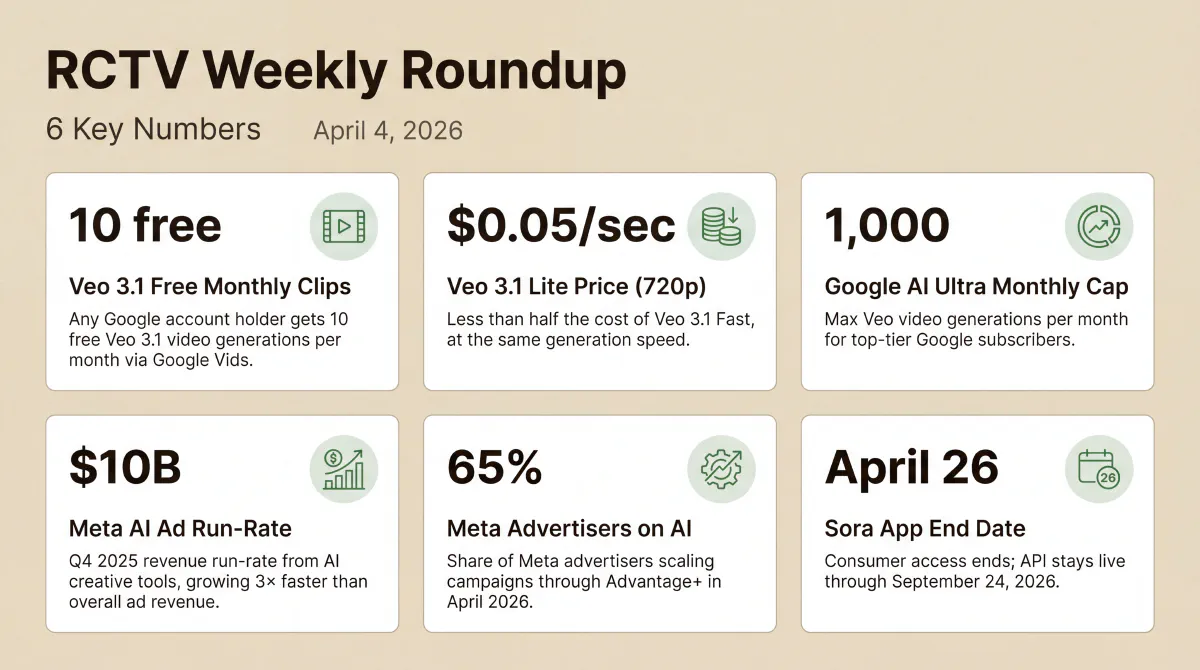
- 10 free — Monthly Veo 3.1 video generations now available to any Google account holder via Google Vids
- $0.05/sec — Veo 3.1 Lite price per second at 720p — less than half the previous Veo 3.1 Fast tier
- 1,000 — Monthly Veo video generation cap for Google AI Ultra subscribers
- $10B — Q4 2025 revenue run-rate for Meta’s AI ad creative tools, growing 3× faster than overall ad revenue
- 65% — Share of Meta advertisers now scaling campaigns through AI-powered Advantage+
- April 26 — Sora app shutdown date; API access continues until September 24, 2026
🔮 What to Watch Next Week
- Veo 3.1 Fast price cut (April 7) — Google committed to reducing Veo 3.1 Fast pricing next Monday; watch for whether this triggers a response from Runway, Kling, or Luma on their own API pricing
- Seedance 2.0 US timeline — ByteDance’s Dreamina rollout continues in emerging markets; the US question remains the industry’s most consequential unresolved legal situation
- Meta Advantage+ creative adoption — With 65% of advertisers on AI creative tools, watch for disclosure of which underlying models power the video generation features and whether third-party AI video companies are involved
For full specs, pricing, and access details on every model covered this week, see the AI Video Generation Tools 2026 reference page — updated every Friday.